I Just Walk
2026-08-11 990 words Travel Journal Extracts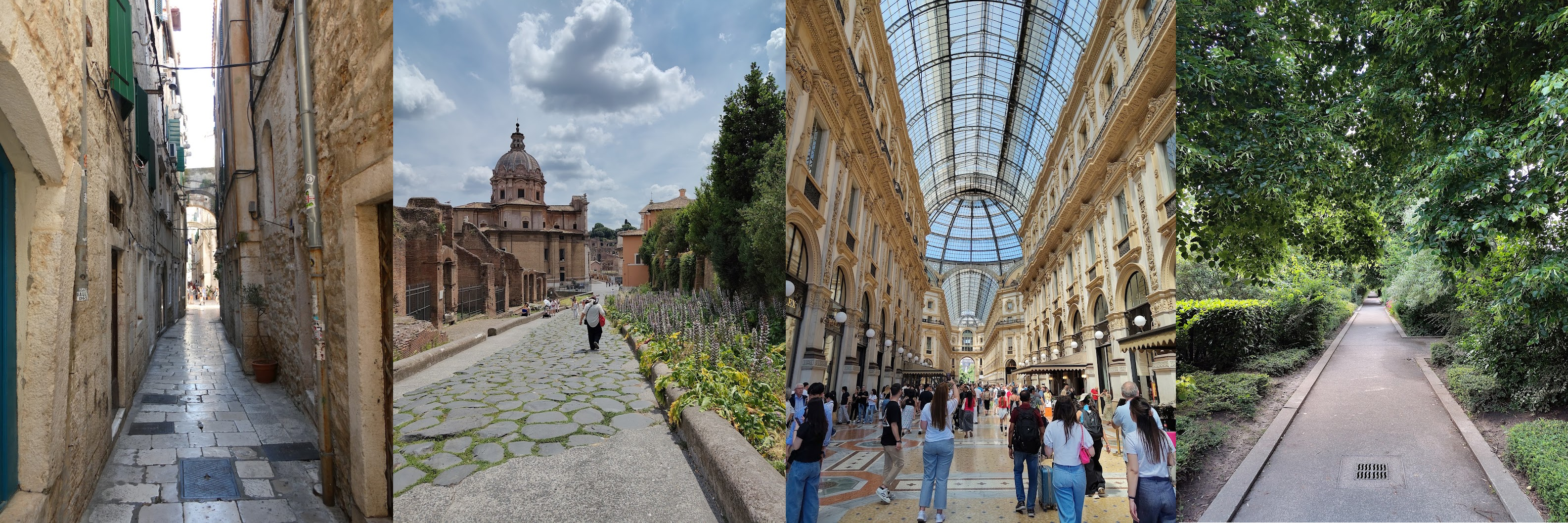
Sightseeing, aimless wandering, aimful wandering, urban hiking, the dérive, flâner, I'm not sure what to call it, because none of those fit. Ultimately, I just walk.
When I'm traveling on my own and I arrive in a city I spend a lot of time just walking it, sometimes with no specific goal, sometimes with a clear goal, and most often with goal that is just a thin excuse to walk. I often chastize myself for not doing more actual things. I tell myself I should plan more rather than walk the city aimlessly, but then I don't. The reason is simple, I like it.
I could call it sightseeing, and sometimes it pretends to be, but it isn't really. The same way that in a nature hike the destination isn't the only part that matters. The waterfall you intend to have lunch at, the top of the mountain with the nice view, it is the walk itself. The less impressive, but still nice, views along the way, the activity itself.
It's the same when I walk. Where I'm walking to isn't that important, it's about just walking, it's about learning to navigate a new place. I'm trying to form a shape of the place in my head by charting it with my feet.
Walking Is a Volume Knob
Walking through a place lets me dial in how much I engage with the place, the noises, and the people depending on my mood. It can be very overwhelming to find yourself in the middle of a large group of people, especially if they are loud.
But none of that bothers me when I'm walking through them. I think that's because walking is a great way to control how much you let in. You can go fast, no one bothers you if you look like you've got somewhere you need to be, or you can go slow and take in every little bit. You can make yourself open to the sounds, or to talking, or you can close yourself off, put on some music, or a podcast, and just stroll through surrounded by a bubble.
Walking through a city is the perfect volume knob. It can be a festival or concert level sensory experience, or it can be as anonymous and isolated as a quiet piece of nature. It's all about how you walk.
Navigating Cities is How I Learn to Love Them
I've found there is a pretty direct correlation between how much I like a city and how well I can navigate it. I don't need to know every inch, but once I learn how to navigate a city I feel like I've learned how it works in a small way. I'm usually only there for a few days as a tourist, so I know in reality I barely know it at all, but as I learn a city's main roads, its areas, the paths that cut through the area to get you around faster, I feel like I've learned what the city actually looks like.
Not the way it looks like from above on google maps, not the way it looks like on a random street, but the way it is shaped, the way it has grown, the way it operates. Something of its core has been revealed when you learn how to navigate inside it, not the big roads, but the logic of the city.
When I return to a city and the paths I would take start to come back to me, when I arrive at the same spot from a different angle, when I cross a path I've taken before, etcetera. I strangely cherish these moments. It's like this strange, fresh place that seems so different, so exciting, so foreign, has become a sort of home in a small way. A place both strange and familiar.
Organic Infrastructure
I tend to like the systems and infrastructure below things, including cities, and the navigational elements are a very organic type of infrastructure. Unless we are talking about designed, American-style, grid cities, the roads grew as much as they were built. The layout of a city, the mechanisms of getting about a city, are shaped by a long history of people moving, building, destroying, rebuilding, partitioning, and reclaiming areas. If something as artificial as a city can be called organic, the most obvious part of that is its layout, its road network and public transport like its veins. And, perhaps, like its veins the way to its heart.
The Tension
If I like just walking cities so much, then why do I still chastize myself for doing it from time to time?
Part of it is a kind of social pressure, I suppose? It feels like you're supposed to do more on vacation than just walk. But that's only a small part of the picture, I don't really care too much about that perception.
It's mainly that I know there are other things I'd enjoy as much, if not more, that I don't do in favour of just walking, because there is more upfront tension, more friction to get started.
During my recent trip to Italy it took until almost the end of the second week before I visited a museum, and it opened up a whole new dimension to the trip. See also: David vs David. If I had pushed myself to do that earlier who knows what other experiences I could've had? It's a trade off between something that comes easy and is usually good in expected ways, and something that is harder to start, but can be better in unexpected ways.